
Roles attach to systems
Ask a room of compliance leads whether their company is a provider or a deployer under the EU AI Act, and most will give one answer for the whole company. Usually it’s the wrong question.
The Act doesn’t assign roles to companies. It assigns them to the relationship between a company and a specific AI system. A bank can be the provider of the model it built to screen job candidates, the deployer of the credit scoring engine it licenses, and the importer of a US vendor’s résumé parser it resells to its corporate clients. All three systems are high-risk under Annex III. That is three roles and three different sets of obligations, all inside one legal entity.
Get the role wrong and you are working towards the wrong rulebook. Article 99(4) sets fines of up to €15 million or 3% of worldwide annual turnover, whichever is higher, for breaching the obligations of any of these roles.
The five roles
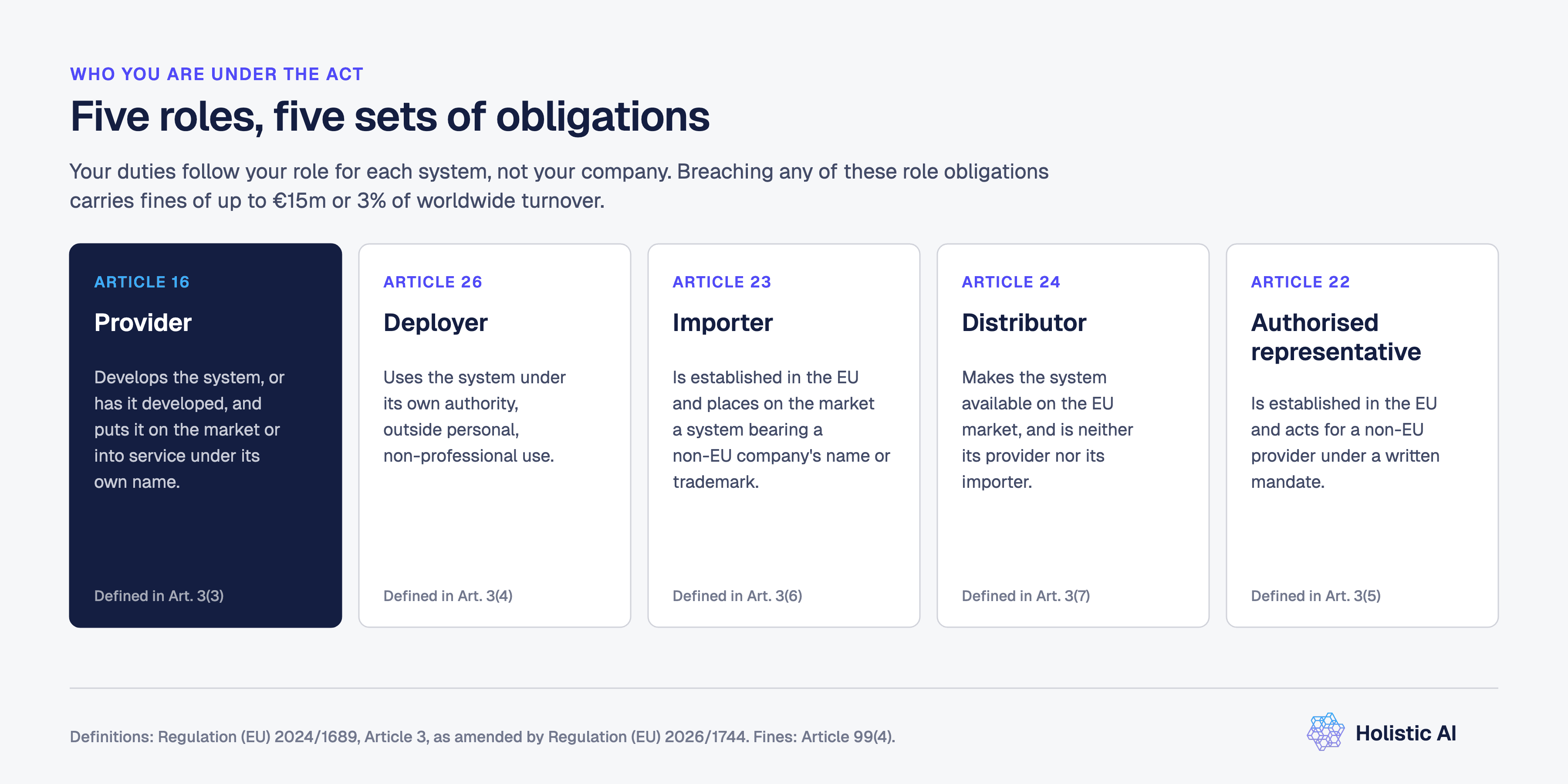
Provider (Article 3(3); duties in Article 16). You develop an AI system, or have one developed, and place it on the market or put it into service under your own name or trademark, whether you charge for it or not. Note the phrase “have one developed”. Outsourcing the build doesn’t make you a deployer. If your name is on it, you’re the provider.
Deployer (Article 3(4); duties in Article 26). You use an AI system under your own authority, in a professional context. It’s the role most enterprises hold for most of their systems, and the one they tend to underestimate.
Importer (Article 3(6); duties in Article 23). You’re established in the EU and you place on the market a system that carries the name or trademark of a company outside the EU.
Distributor (Article 3(7); duties in Article 24). You make a system available on the EU market, and you are neither its provider nor its importer. Resellers, marketplaces and integrators often sit here.
Authorised representative (Article 3(5); duties in Article 22). You’re established in the EU and have accepted a written mandate to act for a provider based outside it. A non-EU provider of a high-risk system must appoint one before making the system available in the EU.
What each role has to do
The obligations aren’t five copies of the same list. The provider carries the build obligations. Everyone downstream is expected to check that those obligations were met, and to stop if they weren’t.
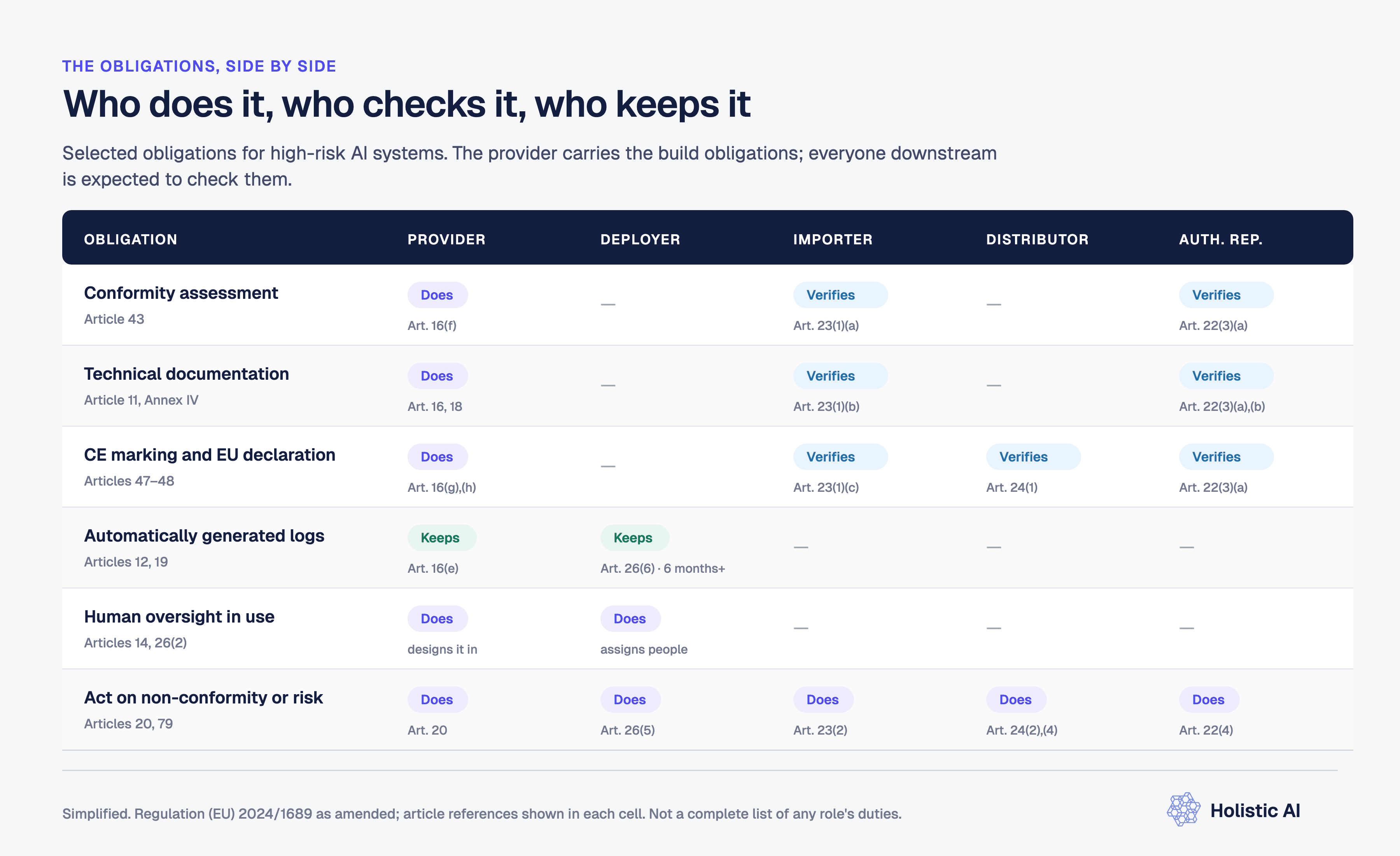
Providers carry the heaviest load. Under Article 16 they must:
- meet the requirements in Chapter III, Section 2, covering risk management, data governance, technical documentation, logging, human oversight, accuracy and cybersecurity
- run a quality management system
- complete the conformity assessment before the system reaches the market
- draw up the EU declaration of conformity and affix the CE marking
- register the system
- keep the logs it generates while they’re under the provider’s control
- take corrective action when something goes wrong
Deployers have a shorter list, but it’s operational. It runs every day the system is in use, not once at launch. Under Article 26 you must:
- use the system according to its instructions for use
- assign human oversight to people with the competence, training and authority to exercise it
- make sure any input data you control is relevant and sufficiently representative
- monitor the system’s operation
- keep its automatically generated logs for at least six months
- if you’re an employer, tell workers’ representatives and affected workers before a high-risk system is used on them
If you have reason to think the system presents a risk, you must inform the provider or distributor and the market surveillance authority, and suspend use.
Importers and distributors are gatekeepers. Before placing a system on the market, an importer must verify four things: that the conformity assessment was done, the technical documentation exists, the CE marking and declaration are in place, and an authorised representative has been appointed where required (Article 23(1)). A distributor checks the CE marking, the declaration and the instructions for use (Article 24(1)). Both must hold the system back if they have reason to believe it doesn’t conform.
Authorised representatives verify the provider’s paperwork and keep it available to authorities for ten years. If the provider acts contrary to the Regulation, the representative must terminate the mandate.
Article 25: when you become the provider
Roles move, and this is where most role mapping goes wrong. Article 25 sets out three actions that turn a deployer, distributor or importer into the provider, with every Article 16 obligation that comes with it.
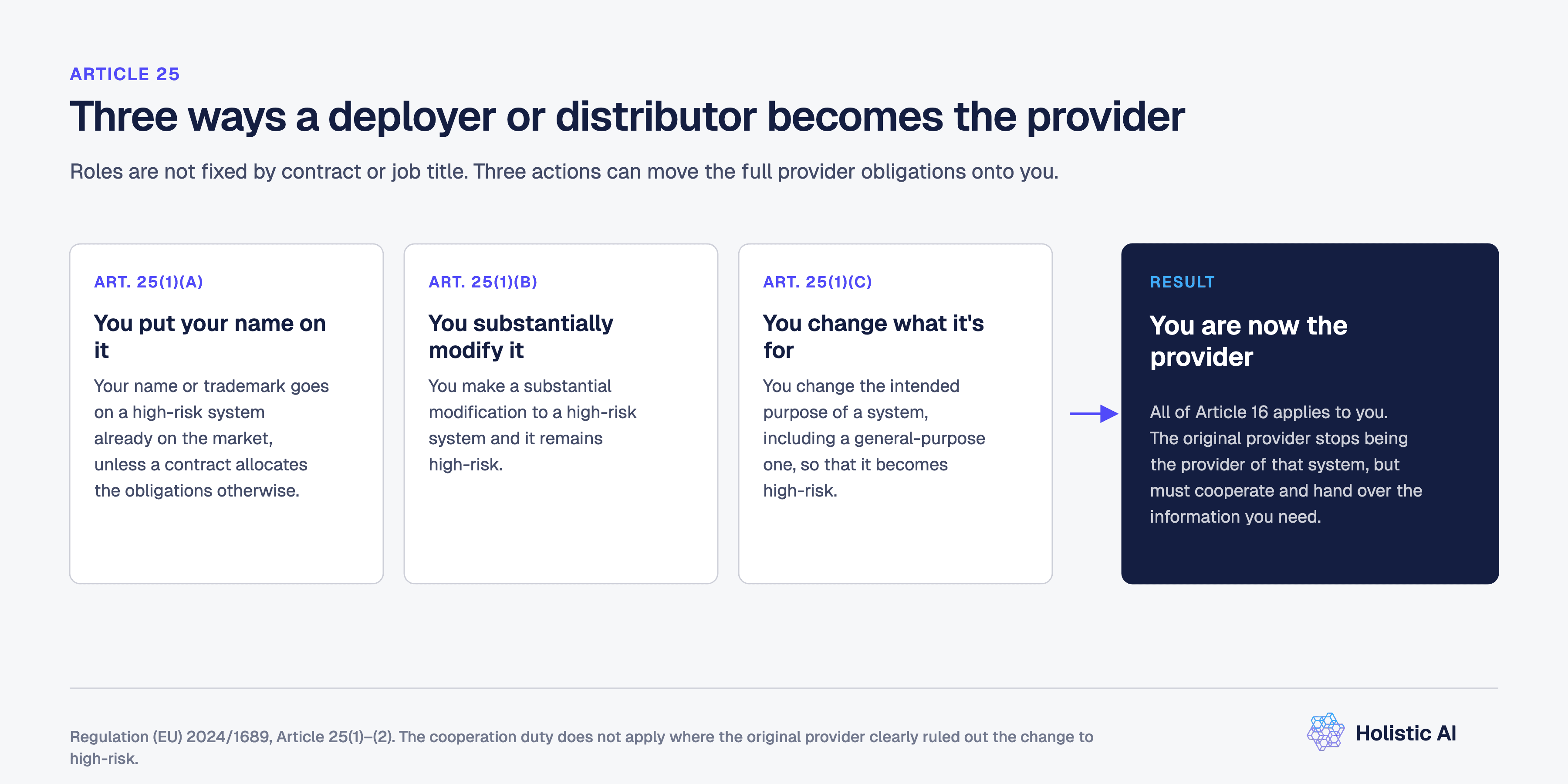
- You put your name or trademark on a high-risk system that’s already on the market. Contracts can allocate the obligations differently, but the default is that the name on the system determines who the provider is.
- You make a substantial modification to a high-risk system and it remains high-risk. “Substantial” has a specific meaning in Article 3(23): a change the provider didn’t foresee in its original conformity assessment, and one that affects compliance or changes the intended purpose.
- You change the intended purpose of a system, including a general-purpose AI system, so that it becomes high-risk. This is the one that catches people. A team takes a general-purpose model, points it at CV screening, and has just become the provider of an Annex III high-risk system.
When that happens, the original provider stops being the provider of that system. It must still cooperate and give you the information and technical access you need, unless it clearly specified that the system wasn’t to be turned into a high-risk one.
So a role isn’t a label you assign once and forget. Check it again whenever a system is rebranded, retrained or repurposed.
Why most programs get this wrong
Most EU AI Act programs start from one questionnaire, and that questionnaire assumes the respondent is a provider.
Deployers end up answering questions about conformity assessments they will never run. Importers aren’t asked the verification questions that actually apply to them. Nobody is asked about Article 25 until a system has already been repurposed. The result looks like coverage but isn’t. Answers get recorded against the wrong obligations, and the evidence a market surveillance authority would actually ask for goes ungathered.
There’s a more basic problem underneath. You can’t assign a role to a system you don’t know you have. When Vision Compliance assessed its clients in 2026, 83% had no formal inventory of the AI systems they use or deploy, and 74% had no designated owner or governance body for AI compliance. EY found that 26% of organizations using agentic AI can’t detect unauthorized agents running inside their own walls. Every one of those unseen systems has a role attached to it. Nobody has worked out what it is.
How Holistic AI handles all five
Our EU AI Act workflow starts with a different question. It doesn’t ask what kind of company you are. It asks what your relationship is to each system.
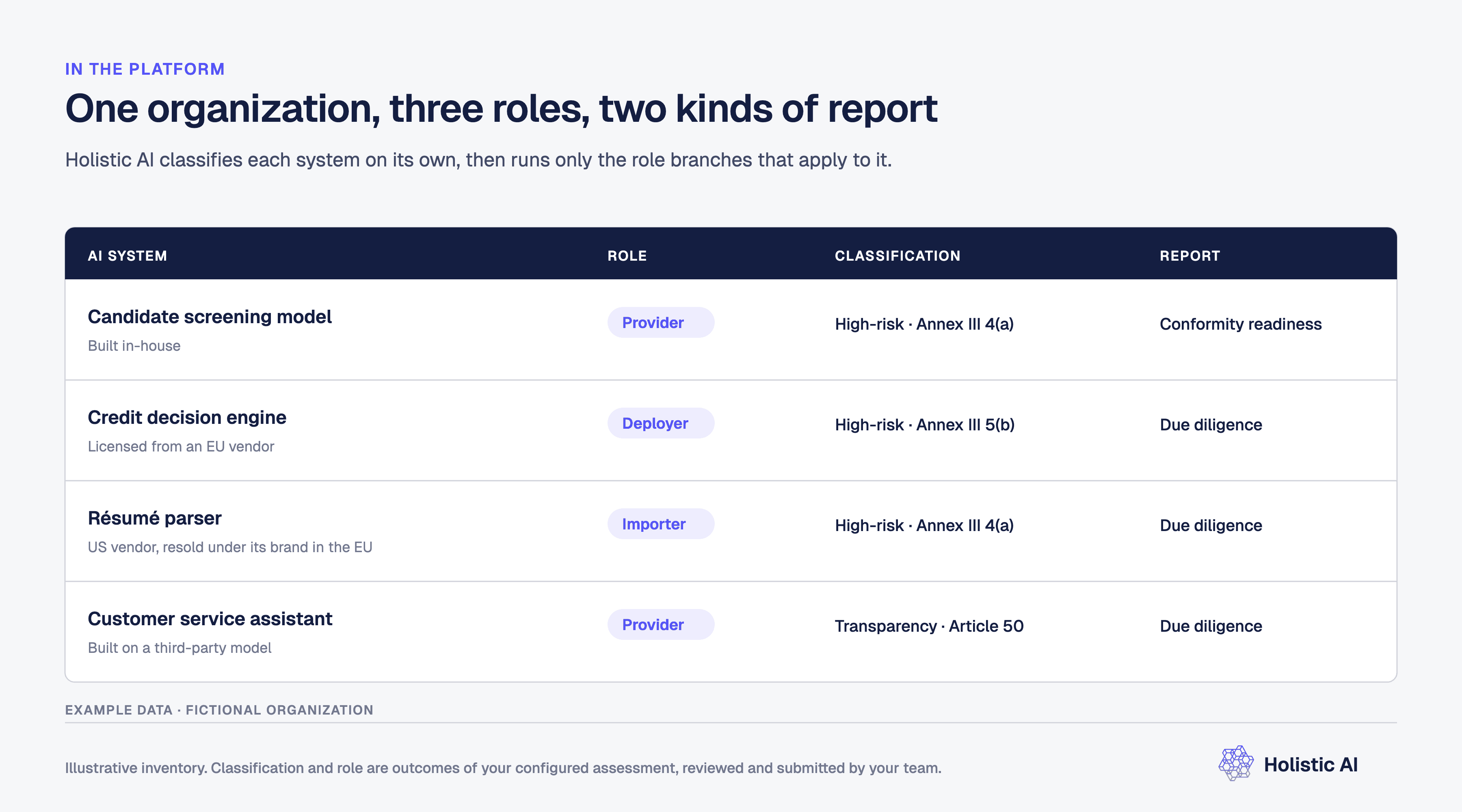
Classification decides the role, per system. Each AI system is classified on its own. The assessment agent drafts the classification from the system’s linked documents, and a person on your team reviews and submits it. The outcome records your role and the system’s risk tier, with the article references behind them.
Only the branches that apply are run. The platform supports separate readiness and mitigation tasks for all five roles: provider, deployer, importer, distributor and authorised representative. Classification switches on the right ones. A deployer is assessed against Article 26, not against a provider’s checklist with half the answers marked N/A. If you hold more than one role for a system, each role gets its own assessment.
Gaps become actions for your role. For every obligation that’s unmet or only partly met, the mitigation agent writes a recommendation and implementation steps for that role. An importer gets verification steps. A deployer gets oversight and logging steps.
Evidence is checked against the obligation it’s meant to meet. Your team records what was done and attaches the documents. The evidence evaluator reads them against the original obligation and proposes a level with its reasoning. A reviewer approves it, changes it, or sends it back. Every level shows whether the agent or a named reviewer set it.
The right report for the route. Providers of high-risk systems get a conformity readiness report: the build obligations, their status and the evidence behind them. Deployers, importers, distributors, authorised representatives and providers of systems that aren’t high-risk get a due diligence report for their role. Every report is assembled from the records that produced it.
Repurposing is visible. Each run is pinned to the version of the assessment it used, and every earlier round stays on record. When a system is rebranded, retrained or put to a new use, your team runs a new classification. The before and after sit side by side, so an Article 25 change has an audit trail rather than a surprise.
Three questions to ask this week
- For each AI system in production, do you know your role, system by system? If the answer is a single word for the whole company, start there.
- Which systems have been rebranded, fine-tuned or repurposed since you bought them? Those are your Article 25 candidates.
- If you’re a deployer, who is assigned to oversee each high-risk system, and where are its logs? Article 26 runs every day the system does.
Want a first read on a single system? The free EU AI Act risk calculator shows which tier and role it is likely to fall into. For how the agents work across the whole workflow, read Meet your EU AI Act agents.
Frequently asked questions
- What are the operator roles under the EU AI Act?
- For AI systems, the main roles are provider, deployer, importer, distributor and authorised representative, defined in Article 3(3) to (7). Article 3(8) groups them, together with product manufacturers, as operators. Each role carries its own obligations: Article 16 for providers, Article 26 for deployers, Article 23 for importers, Article 24 for distributors and Article 22 for authorised representatives.
- Can one company be both a provider and a deployer?
- Yes. Roles attach to the relationship between an organization and a specific AI system, not to the organization as a whole. A company that builds one high-risk system and licenses another is the provider of the first and the deployer of the second, and owes both sets of obligations.
- When does a deployer become a provider under the EU AI Act?
- Under Article 25(1), in three cases: when it puts its name or trademark on a high-risk system already on the market (subject to contracts allocating the obligations otherwise), when it makes a substantial modification to a high-risk system that remains high-risk, or when it changes the intended purpose of a system, including a general-purpose one, so that it becomes high-risk.
- How long must deployers keep logs of a high-risk AI system?
- For a period appropriate to the system’s intended purpose, and at least six months, unless other Union or national law says otherwise, under Article 26(6). The duty covers logs the system generates automatically, to the extent they are under the deployer’s control.
- What are the fines for breaching role obligations?
- Up to EUR 15 million or 3% of total worldwide annual turnover for the preceding financial year, whichever is higher, under Article 99(4). For SMEs and start-ups, the lower of the two applies.
Sources and verification
Every date and provision cited here was checked against the consolidated text on 20 November 2026. The EU AI Act is being amended as it is implemented; where this page and EUR-Lex disagree, EUR-Lex governs.
- Regulation (EU) 2024/1689: consolidated text on EUR-Lex
- Article 3: Definitions
- Article 16: Obligations of providers
- Article 22: Authorised representatives
- Article 23: Obligations of importers
- Article 24: Obligations of distributors
- Article 25: Responsibilities along the AI value chain
- Article 26: Obligations of deployers
- Article 99: Penalties
- Vision Compliance, 2026 EU AI Act Readiness Report, 1 April 2026 (the company’s own client assessments; sample size not disclosed)
- EY, AI Risk and Governance Survey, 15 September 2026 (202 US senior AI decision-makers; the 26% figure is among organizations using agentic AI)
This page is an independent information resource. It is not legal advice, and it does not create a lawyer–client relationship. Take advice on your own facts before making a compliance decision.