
Answers are not evidence
Here is how EU AI Act compliance work tends to go at most companies. Someone in legal sends a spreadsheet to the teams that own AI systems. Engineers fill it in between sprints, mostly from memory.
Answers come back in different formats, a few weeks late. Someone in risk chases the missing ones. A consultant turns the result into a gap analysis. By the time it lands on a director’s desk, two of the systems have changed and one has been switched off.
None of that produces evidence. It produces answers.
The difference matters more every month. Obligations for Annex III high-risk systems apply from 2 December 2027. That covers AI used in hiring, credit, education, essential services and biometrics, and it is about a year away. The Digital Omnibus gave companies more time. It didn’t make the work any smaller.
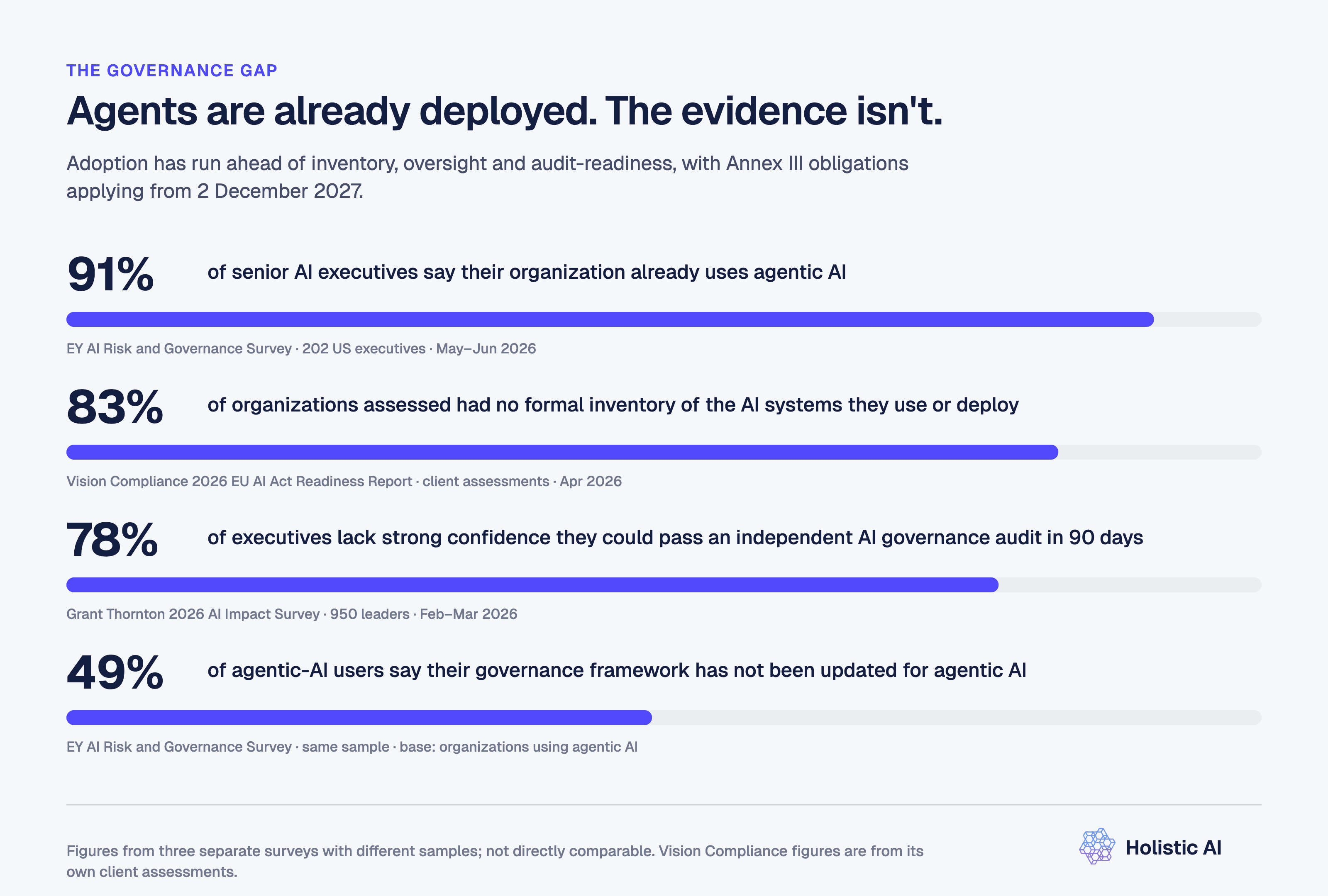
The surveys measure different things, but they point the same way. In EY’s 2026 survey, 91% of senior AI executives said their organization already uses agentic AI. Among those, 85% said at least a handful of their systems act without a person involved in real time, and 49% said their governance framework hasn’t been updated for agents at all. Grant Thornton found that 78% of executives lack strong confidence they could pass an independent AI governance audit within 90 days. Vision Compliance’s assessments of its own clients found 83% had no formal inventory of the AI systems they use.
One Grant Thornton detail stands out. Among organizations still piloting AI, 7% were very confident they could pass that audit. Among organizations where AI is fully integrated, 74% were. Confidence doesn’t come from doing less AI. It comes from having the structure in place.
So companies are deploying agents faster than they can show they are governing them. We think the answer is to put agents to work on the governance as well, inside a structure that keeps people in charge.
Seven stages, two lanes
Holistic AI’s EU AI Act workflow takes an AI system from first context to a finished report in one place. Agents do the reading, drafting and checking. Your team makes every decision that matters, and the platform records who did what.
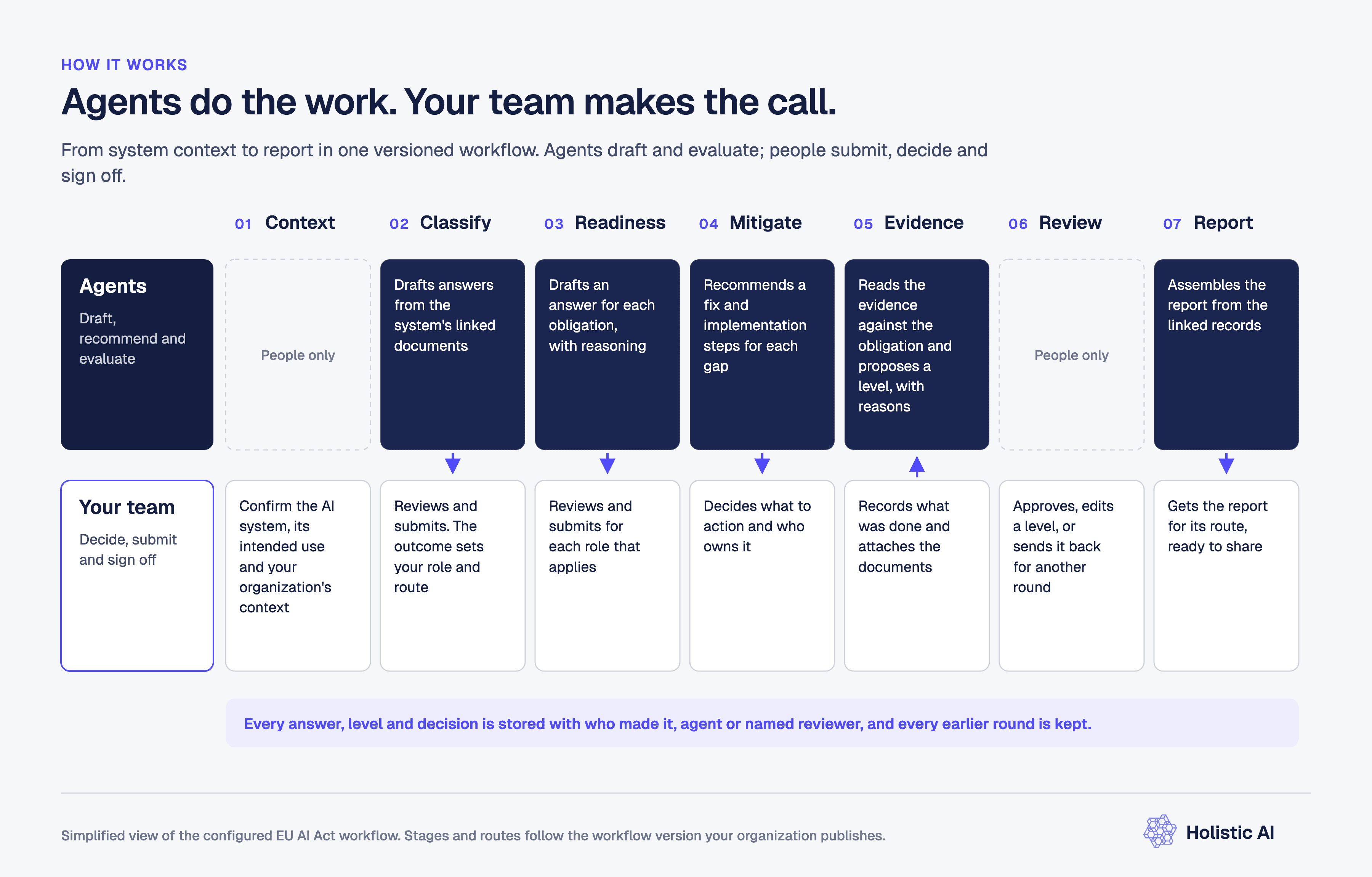
1. Context. Your team confirms which system is in scope, what it is for, and the context about your organization: who you are, where you operate, what you put on the market. Organization answers are reusable, so you aren’t asked them again for every system.
2. Classify. The assessment agent drafts the classification answers from the documents linked to the system. A person reviews them and submits. Nothing an agent drafts is submitted without a human seeing it first. The outcome decides two things: your role for this system, and which route the rest of the workflow takes.
This is the legal classification under the Act. It is deliberately separate from a technical risk score. A model can score low on technical risk and still be high-risk under Annex III because of what it is used for. The platform never lets one stand in for the other.
3. Readiness. The Act recognizes five roles: provider, deployer, importer, distributor and authorized representative. For each one that applies to the system, the agent drafts answers obligation by obligation, with its reasoning. Your team reviews and submits. Each role gets its own readiness assessment, not one blended questionnaire that assumes everyone is a provider.
4. Mitigate. For every obligation that isn’t met or is only partly met, the mitigation agent writes a recommendation and the steps to implement it. Your team decides what to action and who owns it.
5. Evidence. Your team records what was done and attaches the documents. Then the evidence evaluator reads that material against the original obligation and proposes a level, with its reasons.
6. Review. A reviewer approves, changes a level, or sends the work back for another round. Sending it back doesn’t erase anything. The previous evidence, the agent’s assessment and the earlier levels stay on record as a read-only history.
7. Report. The platform assembles the report from the linked records: a classification report with article references, a conformity readiness report for providers of high-risk systems, or a due diligence report for everyone else.
Under the hood
When we show this to risk and legal teams, the first question is rarely whether it works. It’s how. That question usually comes from the person who will have to defend the output to an auditor, so here is the architecture.
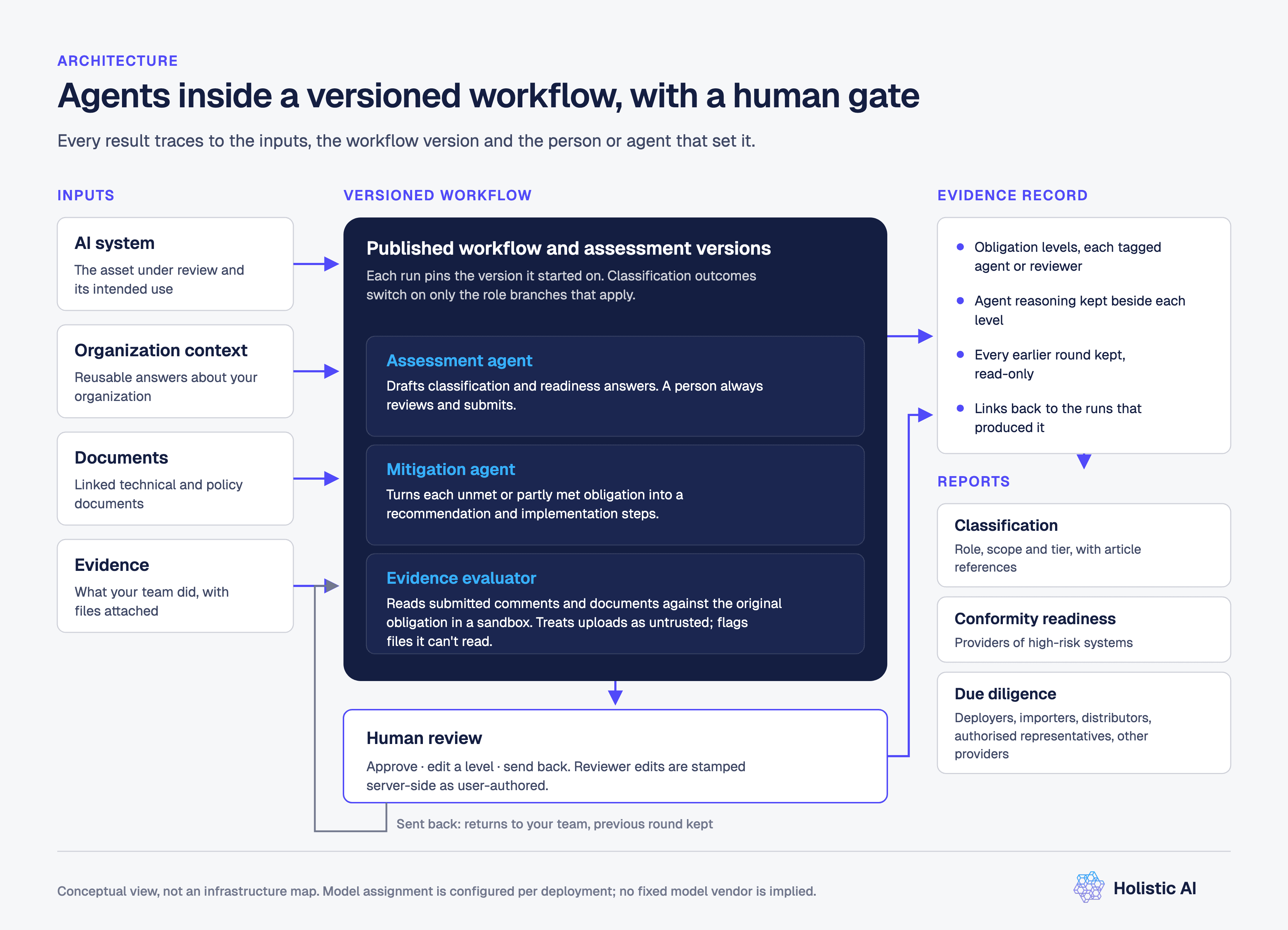
A few design choices are worth spelling out, because they are what make the output defensible.
Every run is pinned to a version. Your organization publishes its workflow and assessment definitions, and each run records the version it started on. When the law or your interpretation changes, you publish a new version. Old results still show exactly which questions they answered. This also means a legal deadline doesn’t silently rerun anything. Reassessment is a decision your team makes.
The evidence evaluator works in a sandbox. It sees the files linked to that specific obligation and the evidence your team submitted, and nothing else. It works through a bounded number of steps. Uploaded material is treated as untrusted input, so a document can’t instruct the agent what to conclude. If a file can’t be read, the evaluator says so rather than assuming it says what its filename suggests.
Every level carries its author. Each obligation level is tagged with whether the agent or a named reviewer set it. The server applies that tag, so it can’t be faked from the browser. If a reviewer saves a level without changing it, it keeps its original author. A reviewer can’t take credit for the agent’s judgment, and the agent can’t take credit for the reviewer’s.
Reports know where they came from. A report is assembled by following references back to the runs that produced it, never by matching filenames. If a classification or an evidence record is missing, generation stops and tells you what is absent. It won’t fill the gap with something plausible.
Model choice is configuration. Each agent’s model is assigned per deployment. We don’t tie you to one model vendor, and the architecture doesn’t depend on one.
A cautious scorer
The agents are useful because they read quickly and consistently. We built the scoring to be cautious for a different reason: a compliance tool that rounds up is worse than no tool.
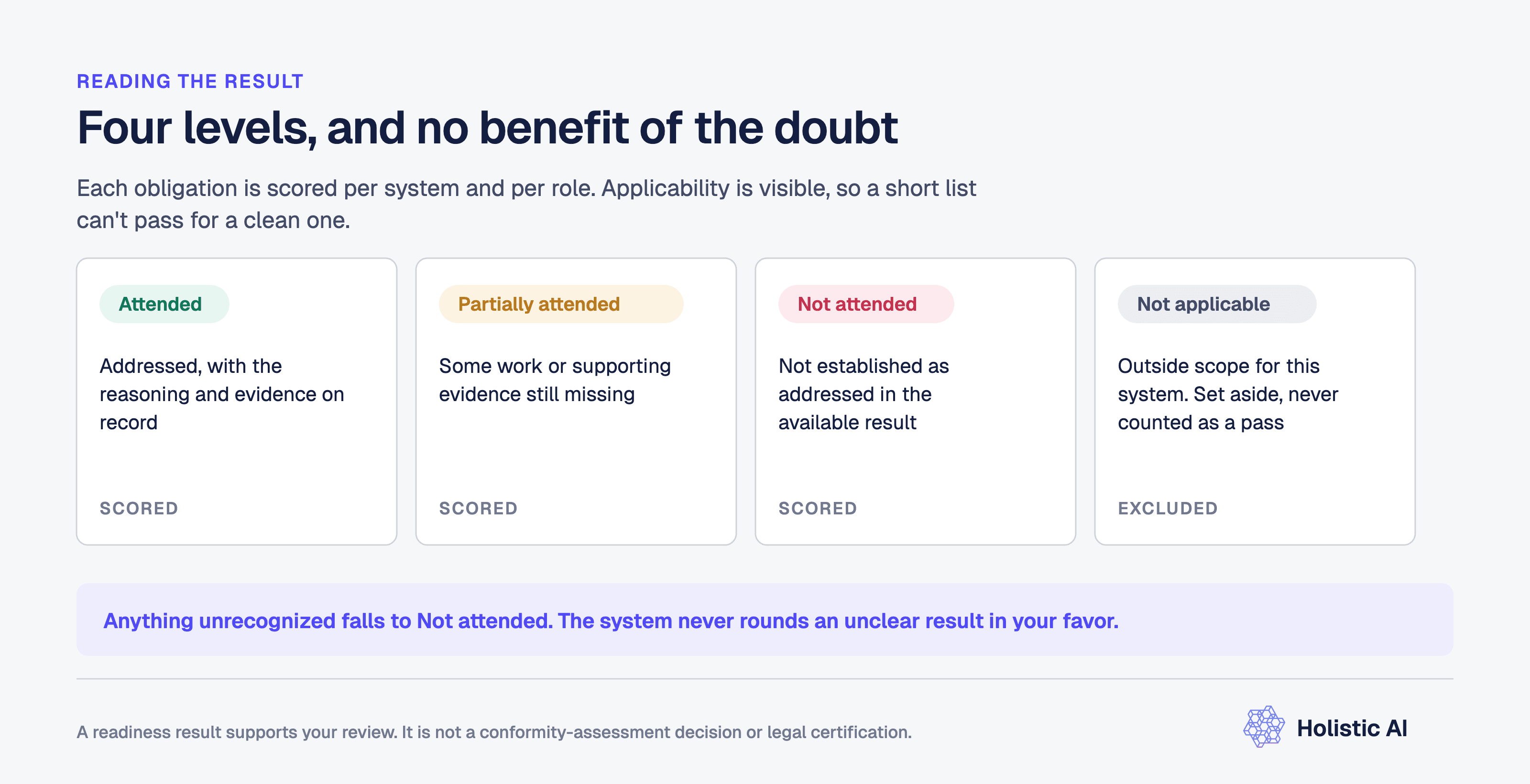
Each obligation ends up Attended, Partially attended, Not attended or Not applicable. Not applicable is set aside rather than counted as a pass, so a system can’t look healthy simply because most of its obligations were scoped out. Any level the system doesn’t recognize is treated as Not attended. The rerun rule is cautious too: once an obligation is marked Attended, a later agent pass doesn’t quietly overturn it. Changing it is a reviewer’s call.
What it won’t do
Some things are worth saying plainly, because buyers ask, and because the answers are part of why the output holds up.
- It doesn’t certify you. A readiness report supports your conformity work. It isn’t a conformity assessment decision, a notified body’s certificate or legal advice.
- It doesn’t decide for you. Agents draft, recommend and evaluate. People submit, approve and sign off.
- It doesn’t recheck on its own. When a system changes materially, your team chooses to reassess, and the new run sits beside the old one.
What changes for your team
- Your engineers stop filling in spreadsheets from memory. The agent drafts from the documents that already exist. Engineers correct the draft instead of writing it.
- Your risk team stops chasing. Every gap has a recommendation, an owner and a status in one place.
- Your legal team gets a record it can defend. Every level has an author, a reason and a history.
- Your board gets a report that matches the system, not the spreadsheet from three months ago.
The Annex III date is fixed. What you’ll have to show for it on the day is still up to you.
Not sure yet which systems are in scope? Try the free EU AI Act risk calculator, or read how the five operator roles change what you owe.
Frequently asked questions
- What do the Holistic AI EU AI Act agents actually do?
- Three agents work inside a versioned workflow. The assessment agent drafts classification and readiness answers from the documents linked to an AI system. The mitigation agent turns each unmet or partly met obligation into a recommendation with implementation steps. The evidence evaluator reads the evidence your team submits against the original obligation and proposes a level with its reasons. People review, submit, approve and sign off.
- Can an agent approve or submit an EU AI Act assessment on its own?
- No. Anything an agent drafts is handed to a person before it is submitted, and only an authorised reviewer can approve the work or send it back. Every obligation level records whether the agent or a named reviewer set it.
- Does the platform certify that a system complies with the EU AI Act?
- No. It produces classification, conformity readiness and due diligence reports that support your conformity work. A readiness report is not a conformity assessment decision, a notified body certificate or legal advice.
- Which EU AI Act roles does the workflow cover?
- All five operator roles: provider, deployer, importer, distributor and authorised representative. Classification decides which roles apply to each system, and each role gets its own readiness assessment.
- What happens when the law or our interpretation changes?
- You publish a new version of the workflow or assessment. Each run is pinned to the version it started on, so earlier results still show exactly which questions they answered. Reassessment is a decision your team makes; a legal deadline does not silently rerun anything.
Sources and verification
Every date and provision cited here was checked against the consolidated text on 20 November 2026. The EU AI Act is being amended as it is implemented; where this page and EUR-Lex disagree, EUR-Lex governs.
- EY, AI Risk and Governance Survey, 15 September 2026 (202 US senior AI decision-makers, fielded 28 May to 15 June 2026)
- Grant Thornton, 2026 AI Impact Survey (950 business leaders, fieldwork 23 February to 18 March 2026)
- Vision Compliance, 2026 EU AI Act Readiness Report, 1 April 2026 (the company’s own client assessments; sample size not disclosed)
- Regulation (EU) 2024/1689: consolidated text on EUR-Lex
- Regulation (EU) 2026/1744: Digital Omnibus on AI (in force 27 July 2026)
- Annex III: high-risk AI systems
This page is an independent information resource. It is not legal advice, and it does not create a lawyer–client relationship. Take advice on your own facts before making a compliance decision.